The first reactions on LinkedIn after Atlassian’s announcement? “Moving to the cloud will be expensive, slow, and unsafe.” We get it. Any big change can give you a bit of a knot in your stomach. But when you step back and look at the facts, a completely different picture emerges: the cloud is no longer a compromise—it’s simply a better way to use Atlassian.
Let’s look at the specifics.
What’s actually changing (and when)
Atlassian Data Center is phasing out in stages. From 30 March 2026, new customers will no longer be able to purchase new DC licences or DC apps. Existing customers can expand and renew until 30 March 2028. By 28 March 2029, Data Center will switch to read-only mode. Until then, technical support, critical vulnerability patches, and cloud connectors will remain fully operational.
There’s no need to panic. This gives us a comfortable three-year window for a calm, well-thought-out migration.
“What about our apps?” – The bogeyman that doesn’t exist
We hear it all the time: “We have add-ons in Data Center that just don’t exist in the cloud.” The reality? The cloud has grown up. A lot of functionality is now native, working much more intelligently than it ever did on DC. Across more than 20 major migrations—covering banking, finance, logistics, IT, and telecoms—we haven’t run into a single business-critical feature that we couldn’t replace or replicate.
Our approach isn’t about a simple 1:1 lift-and-shift; we design end-to-end solutions. We sit down with you to review your processes, data, and apps, stripping away the dead weight. We show you what can be handled natively by the cloud, which parts still make sense as an app, and where bespoke development is actually worth the investment—especially if an integration requires a tailored approach.
Scripts, listeners, and custom code
Yes, scripts (most notably ScriptRunner), post-functions, and listeners will need to be rewritten or replaced. In practice, we combine this with the clean-up step: if it’s genuinely business-critical, we port it over; if not, we simplify. The outcome? A far more stable environment and significantly less technical debt.
“The migration will fail, custom fields will break, and data will go missing.”
Moving native Jira data is straightforward; the real headaches come from legacy schemes and layers of historical customisations. That is why we work iteratively:
Analysis → Test migration → Clean-up → Another test migration → Production cutover → Close support (babysitting)
We usually schedule the switch from one instance to the other over a weekend, always with a solid rollback plan in place. No heroics required—just proper engineering craftsmanship.
“We’re a massive Data Center instance. No one can handle this.”
They can. But it’s a marathon, not a sprint, and it requires a proper plan. On one of our largest migrations, we dealt with 4,000 users, over a million issues, and years of deep customisation. The client initially tried to tackle it on their own—only to give up after several months because the sheer complexity and escalating costs became unmanageable.
When we took over, the path forward was clear: a thorough analysis, multiple test migrations, data and process clean-up, and finally, the live go-live over a weekend with a robust rollback safety net.
The result? In the cloud within a year. And not as a blind carbon copy, but as a simpler, far more sustainable system. For exceptionally large, cluttered instances, the project might stretch to two years—but it is entirely doable, and it delivers genuine value.
Security, encryption, and data residency
“Where will our data live? Who can access it?”
In the cloud, you can choose your data residency region (EU, US, AU, Germany, and others). Access is safeguarded by Atlassian Guard—providing self-service SSO, strict security policies, and detailed reporting. For highly sensitive operations, there is BYOK (Bring Your Own Key) encryption via AWS. Atlassian already offers a FedRAMP Moderate environment for the public sector and is actively working on FedRAMP High / IL5 compliance to ensure it’s ready well before Data Center reaches its end of life.
These aren’t just empty promises; it’s the reality on the ground. In fact, 75% of Atlassian’s enterprise and regulated customers are already running in the cloud.
“The cloud will be slow.”
The reality? Quite the opposite. With Data Center instances, we regularly had to handle outages, painful reindexing processes, or overnight upgrade windows.
In the cloud, the feedback we hear from clients is: “faster response times, fewer crashes, no more midnight patching.” And let’s be honest—your current “on-prem” setup probably isn’t running on a physical server gathering dust in the basement anyway; it’s likely hosted on AWS or Azure. The only difference is that you are the one stuck managing that infrastructure layer.
“It will confuse our users.”
Yes, the user interface is different. But more importantly, it’s more modern and intuitive. Moving from Data Center to the cloud is a bit like trading a basic feature phone for a smartphone. It feels slightly unfamiliar on day one, but by day three, you can’t imagine going back.
To ensure this transition goes smoothly, we always build user adoption into the project: training key users and providing “babysitting” post-migration—offering intensive hands-on support during those first few days while people get their bearings in the new environment.
We won’t leave you to handle it alone.
What about the cost?
We hear this a lot: “The cloud is expensive.” The reality? It really isn’t.
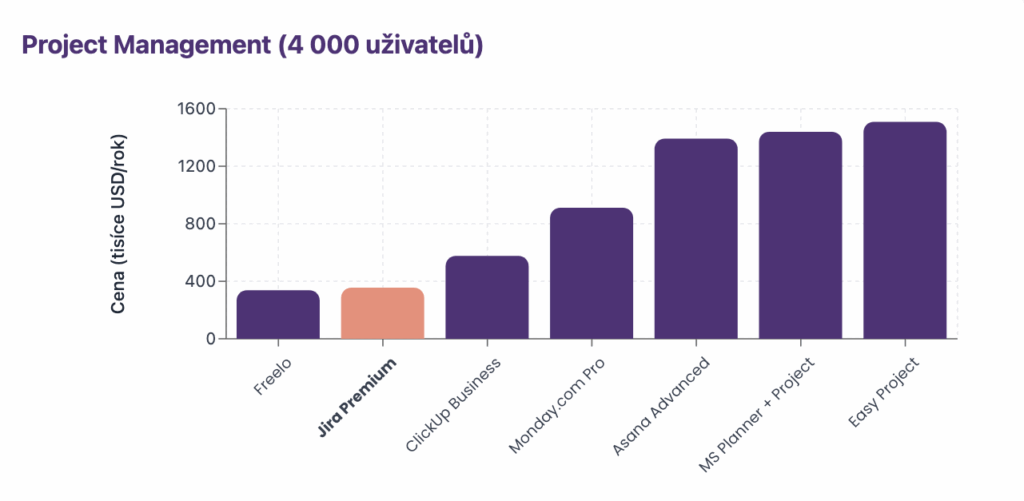
Jira Premium (for 4,000 users) works out at roughly $356,000 per year[1]. To put that into perspective, that’s around the same price tier as tools like Freelo, but if you look at ClickUp[2], Monday[3], Asana[4], or Microsoft Planner[5], you are easily looking at double to quadruple the cost[6].
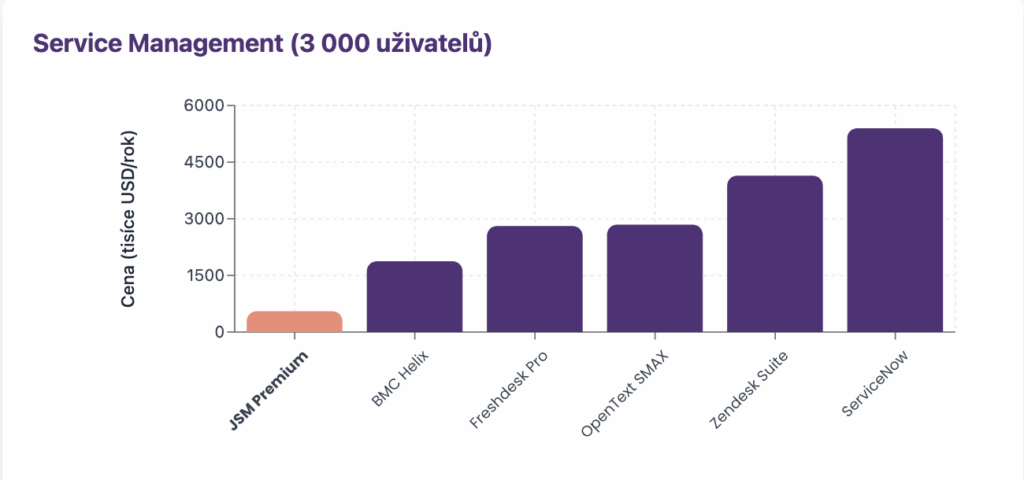
For Jira Service Management (3,000 users), it’s approximately $550,000 annually[7]. On paper, ServiceNow might list at $5.4 million, but the commercial reality for the clients we’ve spoken with is that it still ends up roughly twice as expensive as JSM—even after negotiating the sharpest possible discount.[8][9][10][11]
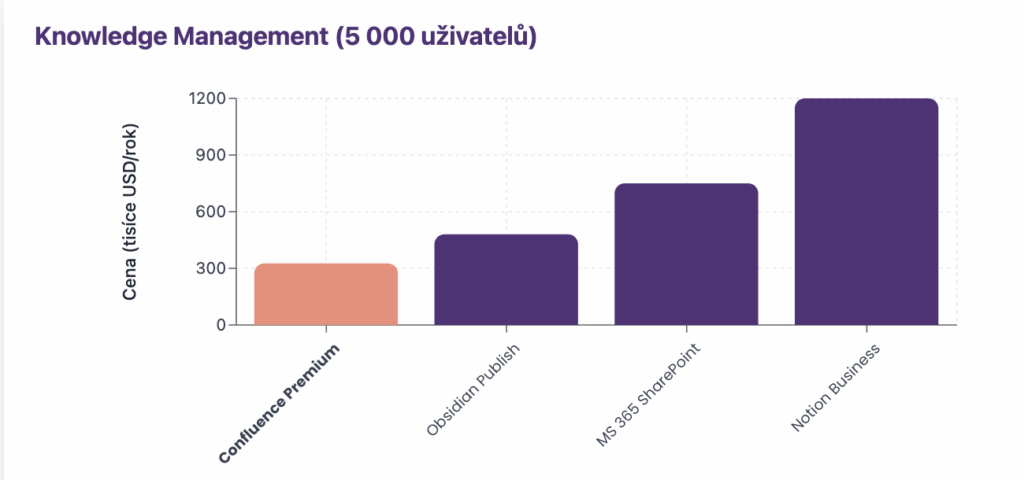
Confluence Premium (5,000 users) costs $326,000 a year[12]. SharePoint / Microsoft 365 will cost you more than double that[13], and Notion is even higher.[14][15]
To be completely transparent, it’s fair to mention that in certain setups (such as enabling SSO via Atlassian Guard), the price will increase. For 4,000 users, it’s about an extra $88,000, and for 3,000 users, around $70,000 annually. Even so, we are still looking at a price point that is highly competitive—and often significantly lower than “other big names” in the industry.
The point isn’t to nitpick and compare every tiny feature down to the last detail. Because honestly, most companies will never use half of them anyway. What actually matters is the overall price bracket—and within that bracket, Jira, Confluence, and JSM sit in the sweet spot: enterprise-grade tools with faster innovation than Data Center, at a price that isn’t sky-high.
Licences are just the tip of the iceberg
The second question we hear all the time is: “Fair enough, but if I’m already on Data Center today, why on earth should I pay more for the cloud?” The answer is straightforward: because licences are only a fraction of the story.
When you factor in everything you pay for outside of your Data Center licence—servers, storage, networking, backups, monitoring, high availability/disaster recovery, upgrade windows, the team running it all, testing, security audits, on-call rotations—the math becomes quite simple: the Total Cost of Ownership (TCO) of the cloud is either lower or highly comparable.
What’s more, the cloud brings advantages to the table that Data Center simply can’t match: faster innovation (with over 1,000 new features released recently), tighter security, native AI capabilities, centralised governance, and seamless integration across the entire Atlassian ecosystem.
Does it make sense to look for alternatives?
Realistically, this isn’t about looking for the exit; it’s about moving forward. If Atlassian makes business sense for you today, there’s a very good chance it will make just as much sense in the cloud—only with far fewer infrastructure headaches and a lot more value built straight into the platform.
If migration is already a burning issue for you, get in touch. We’d be delighted to look over your specific environment and show you exactly what a move to the cloud looks like in practice.
And if you are still just gathering information for now, we are planning an exclusive, intimate gathering in Prague this autumn specifically for Data Center customers. Representatives from both Atlassian and Amazon (AWS) will be joining us. The aim is to have an open, frank discussion about both the technical and strategic sides of migrating. We’ll also be inviting some of our clients who have already successfully made the leap, so you can ask them about their real-world experiences—what worked, what didn’t, and how they find working in the cloud today. We are currently finalising the exact date and venue, so if you’d like to be among the first to receive an invitation, please leave your contact details here.
Alternatively, you can reach out directly to Petr Marcin on +420 602 507 062 or via email at orchestra@morosystems.cz.
When representatives from Česká spořitelna, Y Soft and Volkswagen Financial Services share a stage, you might expect the usual careful talk about digital transformation. But at Elevate ’26, the discussion was far more candid. There was talk of compliance fears, of pushback from headquarters in Germany, and of the fact...
Moving to the cloud is not just a technological challenge but, above all, an opportunity for optimization. A successful migration starts with a thorough analysis of needs and expectations. It’s a chance to eliminate unused applications, unify systems, and set up more efficient processes, leading to savings on licenses and...
Cloud solutions are the future of corporate IT environments. Although migration raises concerns about data security, system customization, and costs, successful projects at companies such as Sazka, CNC, and Česko.Digital prove that moving to the cloud is safe and brings significant, long-term benefits.You can read the full article on Pressmob.cz.